Passwords

According to the Hill, “The White House is funding efforts to wipe out the password as the primary security code used to access sensitive data online.” It is certainly true that passwords are a very weak form of security, although the primary culprit is poor passwords.

However, there is something very creepy—as in creeping government intrusion in our lives—about the federal governments involvement in this.

Update: Just remembered that XKCD had something to say about passwords (of course).
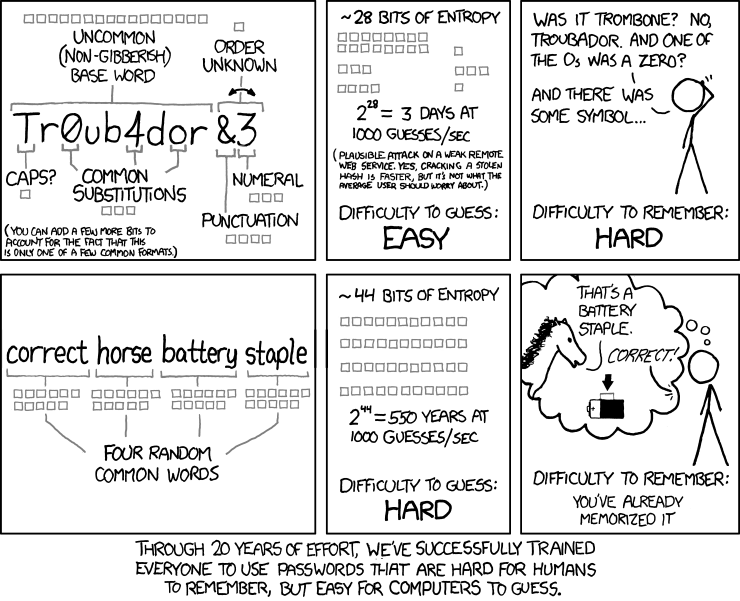
password_strength

Senator Says Carmakers Have No Clue About Hacking

I am quite leery about the Internet of Things. I was leery when I first heard of GM’s OnStar. Sure it was cool that it could send you assistance with the touch of a button. And it is really awesome that it can turn the engine off if someone has stolen your car. (Especially, if it is right in front of the police who were vectored to the same location.) However, these cool features mean that GM knows every where you go and someone can shut off your engine. This is tremendous invasion of your privacy and autonomy.

I read today an article on Popular Mechanics that shows automakers do not know what they are doing and probably do not care. Be afraid.

Justice served

justice served
(see on original site)

This is one of my favorite Dilbert comics. I often use it to illustrate abstraction. For example, there are no “files” on your computer. There are ones and zeroes that are interpreted as such. A file is an abstraction. Just as pretty much everything we do on a computer. Some abstractions are quite useful.

Samsung: watch what you say in front of our TVs, they’re sending your words to third parties

According to the Samsung EULA (who ever reads them?):

Please be aware that if your spoken words include personal or other sensitive information, that information will be among the data captured and transmitted to a third party through your use of Voice Recognition.

This bites. I’m pretty sure I know what I will say in front of my TV tonight. I also think I have bought my last Samsung TV. I wonder how many of these TVs are in bedrooms. That is more that a little creepy.

Read more here.

Privacy, what privacy?

It is possible to identify anonymous customers with only data about four purchases.

Scientists showed they can identify you with more than 90 percent accuracy by looking at just four purchases, three if the price is included – and this is after companies “anonymized” the transaction records, saying they wiped away names and other personal details.

Wow!

My daughter came home yesterday and told me about a web site that presents information about people. We typed in my name, which is fairly unique, it displayed information about where I have lived. She was alarmed. The information was obtained by publicly available knowledge, such as home purchases. There is no privacy anymore. She better understands why I do not want her to use her full name in usernames, such as email.