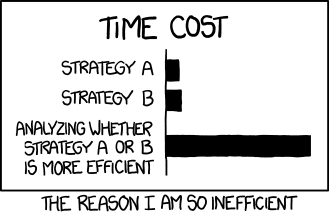
Xkcd is, of course, brilliant. This perfectly captures Haskell.
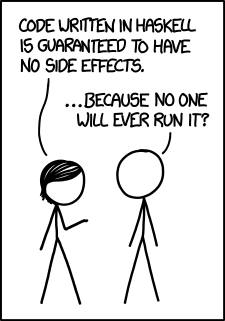

Xkcd is, of course, brilliant. This perfectly captures Haskell.
This Adam Carolla video continues the “bad luck” theme from last post. It is good food for thought. It present an important lesson of life. It will be a subject of discussion with my kids. Adam’s delivery is better and a more acceptable method than parental preaching.
This Heinlein quote should be repeated often. We hope that it is not a prediction.
Throughout history, poverty is the normal condition of man. Advances which permit this norm to be exceeded — here and there, now and then — are the work of an extremely small minority, frequently despised, often condemned, and almost always opposed by all right-thinking people. Whenever this tiny minority is kept from creating, or (as sometimes happens) is driven out of a society, the people then slip back into abject poverty.
This is known as “bad luck.”
In an article at NPR Alva Noë, a philosopher at the University of California at Berkeley, discusses AI.
Artificial intelligence isn’t synthetic intelligence: It’s pseudo-intelligence.
This really ought to be obvious. Clocks may keep time, but they don’t know what time it is. And strictly speaking, it is we who use them to tell time.
And later:
But it’s striking that even the simplest forms of life — the amoeba, for example — exhibit an intelligence, an autonomy, an originality, that far outstrips even the most powerful computers.